Wednesday, July 2, 2014

Most bike friendly cities in the US

Sorry for the silence. I've just spent some time on bikeleague.org and was fascinated by their 2013 city awards, the corresponding criteria, and who has won what. It's a platinum, gold, silver, bronze scale and the results for the top cities are below:


Note that several famous college towns (Boulder, Davis, Fort Collins) fill the highest spots. Portland reaches platinum status whereas Seattle is gold. Other notable college towns fill out many of the gold spots (Eugene, Minneapolis, Madison, Missoula). Salt Lake City is rated silver. If you're looking for a new place to live, the quality of life in each of these towns is quite high. Note the oddity that is Scottsdale (and Tucson to some extent). I guess rich Arizonans are getting on board with great bike infrastructure. And good for them!

Might have to encourage the dear wife to accelerate our tour of the great American cities.

Wednesday, June 25, 2014

Gone

Sorry for the radio silence. I've accepted a position at a new company and, before I start, the wife and I are traveling. Back to the real world (and posting) soon. Happy Wednesday!

Tuesday, June 17, 2014

Which is the world's most successful country?

Building off of this post, I've added employment rates (in %) for those from 25-54 years old and have come up with this table, which ranks various rich countries by several key indicators (click to zoom):


This doesn't get discussed much (although here's one recent post), but note how the US has the lowest employment ratio for those form 25-54 years old. Note that we're talking about employment here and not unemployment. On the right, the overall rank column is a ranking of the sums of the individual ranks. Note that, according to these metrics, the most successful countries in the world (in order) are Iceland, Sweden, Norway, Japan, and Switzerland. Overall, it appears that any talk of the US moving toward European-style tax rates isn't necessarily a bad thing. Northern Europe, with their large social safety net, appears to be doing something very right. In fact, I might try to convince the dear wife that a trip to Iceland is in order.

Source notes:

1. Number of deaths between birth and age 1 per 1000 live births in 2012. Data here.

2. Maternal deaths per 100,000 live births in 2013. Data here.

3. Number of deaths of people between 15 and 60 years of age per 1000 population for 2012. Data here.

4. Life expectancy at birth (in years). Data here.

5. Prisoners per 100,000 population. Data here.

6. Employment rate (%) for those 25-54 years old for 2013. OECD countries here (table 3) and Singapore here (chart 17).

Monday, June 16, 2014

Red meat: So delicious but so many reasons not to eat it

Coming via Matt Yglesias, the Environmental Working Group put together the following chart, which tallies up the amount of CO2 emissions associated with producing a kilogram of various types of food:

Whether it's for health, moral, or environmental reasons, it appears eating less lamb and beef is a responsible thing to do. Interesting how the benefits can come along so many different axes. The jury is still out, however, on how my family's love of California Burger will change as a result.

Note: when reading part of Thoreau's Walden recently, I came across this related passage (page 164):
It is hard to provide and cook so simple and clean a diet as will not offend the imagination; but this, I think, is to be fed when we feed the body; they should both sit down at the same table. Yet perhaps this may be done. The fruits eaten temperately need not make us ashamed of our appetites, nor interrupt the worthiest pursuits. But put an extra condiment into your dish, and it will poison you. It is not worth the while to live by rich cookery. Most men would feel shame if caught preparing with their own hands precisely such a dinner, whether of animal or vegetable food, as is every day prepared for them by others. Yet till this is otherwise we are not civilized, and, if gentlemen and ladies, are not true men and women. This certainly suggests what change is to be made. It may be vain to ask why the imagination will not be reconciled to flesh and fat. I am satisfied that it is not. Is it not a reproach that man is a carnivorous animal? True, he can and does live, in a great measure, by preying on other animals; but this is a miserable way—as any one who will go to snaring rabbits, or slaughtering lambs, may learn—and he will be regarded as a benefactor of his race who shall teach man to confine himself to a more innocent and wholesome diet. Whatever my own practice may be, I have no doubt that it is a part of the destiny of the human race, in its gradual improvement, to leave off eating animals, as surely as the savage tribes have left off eating each other when they came in contact with the more civilized.

Friday, June 13, 2014

Dave Chappelle explains why high marginal tax rates are great

Here's the description from the Upshot:
Dave Chappelle, the comedian who walked away from a wildly successful TV show named for him a decade ago, made his first talk show appearance in ages Tuesday night. He probably wasn’t intending to make an argument about maximizing the efficiency of the tax system in his appearance on the “Late Show With David Letterman,” but that’s what he ended up doing.
Mr. Chappelle discussed the reported $50 million contract he walked away from when he abruptly ended “The Chappelle Show.” Does the loss of all that money haunt him?
“So I look at it like this,” Mr. Chappelle said. “I’m at a restaurant with my wife. It’s a nice restaurant. We’re eating dinner. I look across the room and I say: ‘You see this guy, over here across the room? He has $100 million. And we’re eating the same entree. So, O.K., fine, I don’t have the $50 million or whatever it was, but say I have $10 million in the bank.’ The difference in lifestyle is minuscule.”
His point is about the diminishing marginal utility of rising wealth. If you are flat broke and somebody gives you $1 million, that money significantly increases your quality of life. Going from $1 million to $10 million makes you better off, though probably not 10 times better off. And similarly, going from $10 million to $50 million in net worth creates far less improvement in your quality of life than those early steps of going from broke to $1 million or $1 million to $10 million.
The video of Chappele explaining this is here. Indeed, one of the greatest things about higher marginal tax rates is the marginal utility of wealth. In other words, raising taxes on rich people isn't a zero sum game, because transferring one dollar from a millionaire to a poor person helps the latter much more than it hurts the former.

As Matt Yglesias puts it, "the difference, in welfare terms, between a Sub-Zero refrigerator and an Ikea refrigerator is much smaller than the difference in welfare terms between having health insurance and not having health insurance."

Wednesday, June 11, 2014

Where the jobs are in and around SLC

Just a quick note today. Has job sprawl made suburban job access as good as for those living closer to the CBD? According to data from here, that doesn't appear to be the case. Here I'll show what they call the Employment Access Index for Salt Lake County:


It appears that in SLC proper, South Salt Lake, west Millcreek, and even much of Murray have about twice as many jobs per square mile as most of South Jordan and Riverton. The suburban cities of Draper, Midvale, West Valley City, Sandy, and Cottonwoods Heights appear to fall in the middle of the SL County pack in terms of job density.

Tuesday, June 10, 2014

The fuel efficiency of air travel

The dear wife and I took a 737-800 to Phoenix en route to Orange County over the weekend. If you haven't taken a Southwest flight recently, they're flying many new ~2 year old 737s, which really enhance the flying experience compared with older planes. While I'll go into this more later, I just wanted to note how fuel efficient flying is these days. From here, I find that Southwest's new "737-800 burns 4.88 US gallons (18.5 L) of fuel per seat per hour." Since the plane's cruising speed is 514 mph, that means each seat (or person) gets ~105 miles per gallon when flying on this plane (i.e. 514/4.88). Not too shabby for one person whose contemplating driving over taking a plane. However, if four people are piling into a Prius instead of driving, the calculus changes. Suddenly, the flight is about 26 miles per gallon for the group (105/4) and the car would be around 50 miles per gallon.

Note also that aircraft emissions (due to their altitude) affect the climate more than equivalent emissions from vehicles, although it's hard to nail down by how much.

Friday, June 6, 2014

SLC's World Refugee Day celebrations are tomorrow

For those of you looking for something interesting to check out in SLC tomorrow, World Refugee Day celebrations are going on at Liberty Park. An interesting local event and a great cause.


Wednesday, June 4, 2014

Where to get your weather forecast

From a Nate Silver profile in the New Republic:
At the National Weather Service—one of the least appreciated services that the federal government provides—meteorologists make use of both computational power and their own judgment to arrive at forecasts. The meteorologists’ judgments, according to data from the agency, result in precipitation forecasts that are about 25 percent more accurate, and temperature forecasts that are about 10 percent more accurate, than the computer results alone. Improved forecasts have real human benefit; the National Hurricane Center can now do what it was unable to do twentyfive years ago: make predictions three days in advance of where a hurricane will make landfall that are accurate enough to enable people to evacuate in time.
But some weather forecasts are less accurate because of judgments by forecasters who have other motivations. Most Americans do not get weather forecasts directly from the National Weather Service; they receive them instead from commercial services such as AccuWeather and the Weather Channel, and also from local TV stations, which tailor the government data to their own needs. According to Silver, the forecasts of the National Weather Service are well-calibrated: when it forecasts a 40 percent chance of rain, it actually does rain 40 percent of the time. The Weather Channel, in contrast, has a slight “wet bias.” When there is a 5 percent chance of rain, it says that the odds are 20 percent because people are angry at a forecaster when they leave home without an umbrella and get soaked, whereas they are delighted when they take an umbrella and the sun shines. But it’s at the local level that forecasts get seriously distorted. According to a study of Kansas City stations, the local weathermen provide much worse forecasts than the National Weather Service and are unashamed about it. (“Accuracy is not a big deal,” one of them said.) Again, television does not reward accuracy because ratings come first.
Indeed, the weather forecasting coming from local TV news outlets as well as the Weather Channel is generally held in disdain by those in university atmospheric science departments. Nate's great book, the Signal and the Noise has much more on these and other types of prediction. Note that iOS gets its weather info from the Weather Channel (via Yahoo). This is easily solved, however, as one can add a desktop icon for your local forecast from the National Weather Service.

Tuesday, June 3, 2014

Checking in with Lyft and Uber in SLC

I had a great Lyft experience over the weekend, which I'll have to detail soon. In the meanwhile, however, I wanted to check in with how Lyft and Uber availability compares in SLC as of this morning.


Note that both Lyft and Uber are showing availability in Salt Lake City proper this morning. As has been the case since the Uber launch, Lyft consistently shows greater availability near the central business district. I can't tell, however, if that's because Lyft has more drivers there or if the free rides Uber is giving away are keeping its drivers constantly busy.

Here's how to get up to 20 free Uber rides through June 9th.

Here's how to get a free Lyft ride.

Monday, June 2, 2014

Delicious $15 dinners for two in SLC

Moochies being Moochies
Ever since we did the post about $10 dinners for two in SLC, we've wanted to put together a list of places suited for $15 dinners. Well, after much deliberation we've come up with what we think is a pretty stellar list.

1) Moochies -- This place stole our heart last year and the relationship has only gotten more intimate. We love them for their meatball and philly cheese sandwiches as well as their perfectly crispy, battered french fries. The Italian sausage sandwich is also worthy of attention. For a large sandwich sandwich, fries, and a drink it's ~$14-15 and the sandwich is certainly enough for two people. They're at 232 E 800 S or 7725 S State. One trick is that instead of the soda, one can get an extra portion of fries (which we'd recommend) or a choice of several other goodies. Here they are on Yelp and Google.

2) Ali Baba -- While I always find Indian food to be weirdly expensive, Ali Baba breaks the mold and provides delicious Pakastani/Indian fare at a very reasonable price. The samosas here are large and quite delicious. They also provide very solid and tasty portions of classics such as tikka masala, chicken korma, balti chicken, dal, and other lentil-based dishes. The very large menu is here. The garlic naan is also tasty and cheap. One can get samosas or naan and a meat-based dish (to share) for ~$15. Get a veggie dish with both the naan and samosas for ~$15. One tip with this place is that the atmosphere isn't the best (and I don't have high standards). The food's also prepared from scratch and may take a bit, so one would probably be best served by calling ahead and picking up the food to go. 2646 S 700 E. On Yelp here and Google here.

3) Pie Hole -- Pizza has always presented a conundrum. It's hard to get on the cheap for dinner, but often so so delicious. My wife and I were delighted to find that the Pie Hole solves this problem, as the pizza is great and it's sold by the slice at night (unlike the Pie). That makes for a winning value combination and we're excited about it. It's also a great spot for late night eats, which SLC isn't great at providing. Pie Hole is open till 2AM even during the week. Six slices can be had for ~$15. 344 S State. Yelp/Google.

4) Siegfried's -- Siegfried's proves to be an exceptional value in terms of the food. Think delicious bratwurst, schnitzel, goulash, spaetzle, and hot potato salad. While this is a delicatessen, we think it still makes for a great date spot, as it's in the middle of downtown and has ample seating, some of it far from the counter. If you've never had spaetzle, this is a great place to try it. At Siegfried's it's basically noodles and brown gravy. Need I say more? A bonus here is that most entrees come with two sides, which lets one try many of the dishes. Two entrees will run you ~$15. If you're coming for dinner, note that it's open till 9PM Thu-Sat and only till 6PM Mon-Wed. 20 W 200 S. Menu here. Yelp/Google.

5) Guero's  -- This place is all about tortas and juice and flies very much under the radar. The tortas (we usually do al pastor and milanesa) each offer unique and impressive tastes, are full of fresh ingredients, and came on delicious bread. Juices come in what seemed like a gallon-size glasses and are fresh, chilled, and delicious (we love the cantaloupe). The owner of the restaurant is super nice and is usually surprised when we come to sit down and eat (he always thinks we're there for the bakery, which is also delicious). Two tortas and juice should run your $15 and change. 261 E 3300 S. Menu is here.

Guero's torta
Guero's juice

Enjoy, and let us know your favorite cheap and delicious dinners in SLC!

Friday, May 30, 2014

SLC is less than seven hours away from eleven national parks

Just a quick note before the weekend. One of the main benefits (obviously) of living in Salt Lake City is the fact that one is surrounded by amazing outdoor recreation opportunities. This is true both in terms of the canyons that surround SLC, but also in terms of the many national parks just a few hours away. I thought I'd note the driving time (using Google Maps estimates) to each of these parks for quick reference:


So much to see! Even though we're headed into the busier summer season, my wife and I have found that many sections of these parks can be relatively empty even over holiday weekends. Enjoy!

Thursday, May 29, 2014

Lyft and Uber are now operating in SLC and could drastically change local transportation

Lots of new and exciting SLC transportation options have appeared over the last few weeks. First, Lyft, an
The 'staches are now roaming SLC
app-based ride sharing service, launched locally April 19th and appears to be thriving. Second, Uber SLC appears to have officially launched on Tuesday (more below). How Lyft works is that local residents work (part or full time) as Lyft drivers and provide a taxi-like service that's cheaper, faster, and much more convenient than regular taxis. To use it, all you do is download the Lyft app, enter credit card information, and then request a driver. If you live within the I-215 loop, drivers are often close. Last night I saw about 10 cars in the downtown area; here's how things look at the moment:


Lyft typically costs around 30% less than a comparable cab ride. Lyft drivers do go through a background check and the company provides plenty of insurance. Apparently the pricing structure varies by city and time of day; I'm going to do some on-the-ground research on this and post more on this soon.

Here's a code for a free ride (up to $25) for new Lyft users.

Uber, which was founded in 2009 and is now in dozens of cities, just Launched in SLC on May 27th. This company provides a similar car-sharing service to Lyft and is providing 20 rides for free (per customer) through June 9th to celebrate their launch. Here's the coupon code and main SLC page.

These two new transportation options are fabulous for consumers and I'm excited to wrote more about them in the coming weeks. Already, though, traditional taxi companies are complaining and the city may look to further restrict how Lyft and Uber operate locally. In this case, I would urge SLC government to stay out of the way and let consumers decide what works. Much more to come!

Wednesday, May 28, 2014

The monthly costs of owning a house around SLC

Recently we looked at what percentage of SLC paychecks are going towards housing (by neighborhood). We saw that people in fancier areas are often over-extended on their houses. Relatedly, I've been fascinated about the trade-off people often make, moving further away from the city for cheaper housing and trading it for a longer commute. I want to see how this works in SLC (and if it's worth it). First, we've noticed that South Jordan is growing and building like crazy. In the post mentioned above, we noticed that those moving out to South Jordan and other neighborhoods further from SLC proper aren't typically spending a smaller percent of their paycheck on housing than those nearer the city center. But I wasn't sure if that was because people living in those areas have smaller paychecks to begin with, or if the housing out in the further-flung reaches of the valley is just as expensive as that in SLC itself. Overall, are people moving further from the city to save money on housing or to be able to buy a bigger house (both because there's more space and cheaper housing per square foot)?

Again, we turn to this data to attempt to answer the question. Here I'll plot average monthly housing cost in and around SLC:


Interestingly, people are typically spending more on housing costs in West Jordan, South Jordan, Herriman, and Draper than they are in Murray, Midvale, Millcreek, and SLC proper. Amazingly, monthly housing costs in the lower Avenues as well as East Millcreek and Canyon Rim are consistently cheaper than are housing costs in South Jordan. This is hard to believe, but appears backed up by SL Tribune data (on house prices by zip code) here. Overall, it appears people are flocking the fringes of the Salt Lake Valley because they desire an enormous house, not because they want to save money.

Note: I conclude that the higher housing costs in South Jordan, West Jordan, etc are mainly due to house size (compared to the rest of the valley) because it doesn't appear that prices are being driven up by a lack of supply in these suburban areas. If anywhere, SLC proper has the constrained supply of housing. I would love house size by neighborhood data if anyone has it.

Also note: if house down payments (as a percentage of house price) vary strongly across the valley, this would change the analysis somewhat, but until we have that data we'd have to guess people are using (typically very small) down payments of roughly similar percentages.

Tuesday, May 27, 2014

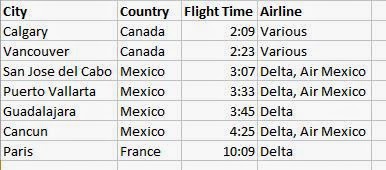
SLC has direct international flights to where?

Just as sort of a housekeeping note, I wanted to list the direct flights to foreign cities from SLC International. I recently found out the Tokyo direct flight had ended a couple years back and wanted to see what the current situation is at SLC Intl.


Looks like seven international direct flights for now to three countries. A list of all direct flights from SLC International can be found here.

Friday, May 23, 2014

Where are SLC residents most over-extended on their houses? It's where the "rich" live

Despite the fact that society thinks people who live in big houses are rich, one's level of consumption can be so deceiving in terms of accurately describing the person's true financial status to the rest of society. It's so odd that most cultures still use items of conspicuous consumption as some sort of barometer for the individual consumer's financial health. And it's insidious, even today, after the debt-fueled melt down of 2009 left millions of over-extended families, corporations, and even cities up a perilous creek. Certainly the Salt Lake Valley contains its fair share of those flaunting their non-existent wealth by buying the large house, huge truck, or fancy car. But, where does this charade happen the most? Where are people most over-extended on their house? We once again turn to this database for the answer, which brings us a map of housing costs as a percent of household income:


First, the census bureau states that spending more than 30% of one's income on housing costs is perilous to one's finances. This site says families should stay below 28%. But what are people in SLC actually doing? Interestingly, in SLC proper the upper-most parts of the Avenues are the most over-extended on their houses, where such costs are taking more than 45% of families' monthly paychecks. Note that the other largest swath of people buying too much house for their paycheck is in the opposite end of the valley, between Sandy and Draper, up along the mountains. In fact, Draper in its entirety is above 30%. Surprisingly, South Jordan residents also look to be spending a disproportionate amount of their checks on housing (30-40%) compared with the rest of the valley, even though the city's known for rapidly increasing its housing supply. I figured people were moving to South Jordan in droves because it was good for their finances, but that doesn't look to be the case.

Here's SLC proper:


Funnily enough, those most over-extended on their house are those in the Capitol Hill area, highest parts of the Avenues, in Federal Heights, and in the Harvard Yale District, with a couple of other pockets of over-extension south of I-215.

Potential lessons here? In SLC, those living in particularly fancy areas are generally having a harder time paying for their housing than the rest of us. People who spend lots of money on houses don't necessarily have great jobs! Also, people who are moving out to South Jordan, West Jordan, and Draper don't have an easier time paying their mortgage than those who live closer to SLC proper.

Thursday, May 22, 2014

SLC household income by neighborhood

Yesterday, I wrote about housing and transportation spending in SLC using a newly-found dataset. Today I thought I'd put up a map from the same site on household income by neighborhood, as what it shows doesn't fit with my preconceptions.


While the legend is cutoff (for overall compactness), you can extrapolate, or zoom as you wish here. What I hadn't realized before is that the Salt Lake Valley is no longer defined by an east-west income gradient, as seemed to be the case for much of the valley the past couple of decades. Interestingly, all along the I-15 corridor, we find that household income is lowest near I-15, but is significantly higher toward the mountains on either side. Surprisingly, West Valley City and Kearns household incomes are notably higher than those in South Salt Lake or even Millcreek. Seeing how incomes are relatively low near I-15, but housing and transport spending (as % of income) there is also relatively low, those areas must have an amazing combination of either low house prices and/or fantastic transit access. We'll suss this out in future posts.

Ty Burrell loves SLC, and doesn't care who knows it

For those of you not aware, Ty Burrell, of Modern Family fame, lives in SLC much of the year and co-owns Bar-X at 155 E 200 S. In March he and several co-owners opened the Beer Bar just next door. And apparently he really really loves SLC, and is quite effusive about it. This appeared on the Huffington Post yesterday:
Dear Salt Lake City,
Ours has been a relatively brief love, but a strong one nonetheless. I met you in 1999 when I did a play at the Pioneer Theatre Company as a way of spending more time near my girlfriend, now wife, Holly. I loved you immediately for your humility and your unassuming nature.

Over the next 10 years my wife and I travelled back and forth to spend time with family and began to fall deeper in love with your incredibly affordable lifestyle and immediate access to the outdoors. We fell so deeply that we didn't feel like we could be apart anymore and we moved from New York in 2008.

I'm sorry but over the past 6 years we've become stalkers. It's your fault. We didn't realize the incredible impact that having the differing viewpoints of both the religious and secular populations of Utah would have on us. So many cities are actually mono-cultures and Salt Lake has an inherent diversity that's not always apparent. We didn't realize that the earnest, good nature of your citizens would lead to a feeling of wanting to pitch in even more, or that it would lead to us investing in this growing community. Nor did we realize that the same qualities of affordability and proximity to nature that brought us here would also bring thousands of creative folks wanting to raise their families in this ridiculously beautiful place.

I'm fairly certain that you're about to explode onto the national scene in the way that some other smaller cities have in the past 10 years. I will try to keep my jealousies at bay as people move here. I'll make you a deal. If, as you grow, you pay attention with great detail to traffic, air quality, conservation, affordable housing, and social justice, then I will work hard to never get so weirdly possessive that you need to take out a restraining order.

With Love, Ty

Wednesday, May 21, 2014

Where in SLC do people spend most of their paychecks on housing and transportation?

When deciding where to live, one of the trade-offs people often make is enduring a longer commute to be able to enjoy the lower house prices available on a city's periphery. Is that a smart trade? An amazing housing and transportation affordability index provides perspective at the neighborhood level, and here's what the Salt Lake Valley looks like, in terms of the percent of one's paycheck spent on housing and transportation:


It's hard to make fair comparisons here, as houses vary in size from area to area. So we can't say those living in the core are getting more housing sq ft and job access per dollar than those on the periphery. Incomes also, of course, vary by area. What we can say, however, is that those living near SLC's CBD and near I-15 do spend less of their paychecks on housing and transportation each month than those living in places like Draper, Herriman, and most of South Jordan (by up to 20%). The particular sweet spots appear to be the east side of SLC's CBD and South Salt Lake. The site also has great maps on local incomes, vehicle miles traveled, population density, car ownership, and transit costs. Good stuff!

Tuesday, May 20, 2014

Utah's gas tax in 1927 was double what it is today

Not sure if you've noticed, but The Atlantic has started a new site called CityLab, which has been producing all sorts of interesting articles on issues faced by US cities and states. The article of interest today discusses how many states' gas taxes are at record lows. And, yes, Utah is one of them. I'll keep this brief, but this following chart shows how Utah's gas tax today compares with what it was in 1927.


It turns out Utah's gas tax in 1927 was twice what it is today (!), after adjusting for inflation. And in 1927 we didn't know that air pollution kills ~94,000 people per year in North America, that climate change may threaten our way of life, that living at lower density makes us poorer and less productive, and that driving makes us fat. We could discourage all of these things with a higher gas tax.

In addition, Utah is facing a $15 billion shortfall in its transportation budget over the next 30 years. See page 32 of Utah's Unified Transportation Plan for more. So it appears that a higher gax tax would be extremely helpful in that realm too.